Four Critical Issues That Frequently Occur in Chemically Dependent Families.
What is drug addiction?
Addiction is defined equally a chronic, relapsing disorder characterized by compulsive drug seeking, continued utilize despite harmful consequences, and long-lasting changes in the encephalon. It is considered both a complex brain disorder and a mental illness. Habit is the well-nigh severe course of a full spectrum of substance utilize disorders, and is a medical affliction caused by repeated misuse of a substance or substances.
Why written report drug employ and habit?
Use of and addiction to booze, nicotine, and illicit drugs cost the Nation more than $740 billion a twelvemonth related to healthcare, crime, and lost productivity. In 2016, drug overdoses killed over 63,000 people in America, while 88,000 died from excessive alcohol use. Tobacco is linked to an estimated 480,000 deaths per year. (Hereafter, unless otherwise specified, drugs refers to all of these substances.)
How are substance use disorders categorized?
NIDA uses the term addiction to draw compulsive drug seeking despite negative consequences. However, addiction is not a specific diagnosis in the fifth edition of The Diagnostic and Statistical Manual of Mental Disorders (DSM-five)—a diagnostic manual for clinicians that contains descriptions and symptoms of all mental disorders classified past the American Psychiatric Association (APA).
In 2013, APA updated the DSM, replacing the categories of substance abuse and substance dependence with a single category: substance utilize disorder, with three subclassifications—mild, moderate, and severe. The symptoms associated with a substance use disorder fall into four major groupings: dumb control, social harm, risky utilize, and pharmacological criteria (i.e., tolerance and withdrawal).
The new DSM describes a problematic pattern of use of an intoxicating substance leading to clinically meaning damage or distress with 10 or xi diagnostic criteria (depending on the substance) occurring within a 12-calendar month menses. Those who have two or three criteria are considered to have a "mild" disorder, four or v is considered "moderate," and half dozen or more symptoms, "severe." The diagnostic criteria are as follows:
- The substance is often taken in larger amounts or over a longer period than was intended.
- At that place is a persistent desire or unsuccessful endeavor to cut down or control use of the substance.
- A great deal of time is spent in activities necessary to obtain the substance, use the substance, or recover from its furnishings.
- Craving, or a strong desire or urge to use the substance, occurs.
- Recurrent use of the substance results in a failure to fulfill major role obligations at work, school, or home.
- Use of the substance continues despite having persistent or recurrent social or interpersonal bug caused or exacerbated by the effects of its use.
- Important social, occupational, or recreational activities are given up or reduced because of employ of the substance.
- Use of the substance is recurrent in situations in which information technology is physically hazardous.
- Apply of the substance is continued despite noesis of having a persistent or recurrent physical or psychological trouble that is likely to take been caused or exacerbated by the substance.
- Tolerance, every bit defined past either of the following:
- A need for markedly increased amounts of the substance to achieve intoxication or desired effect
- A markedly diminished event with continued apply of the same amount of the substance.
- Withdrawal, as manifested by either of the following:
- The characteristic withdrawal syndrome for that substance (every bit specified in the DSM-v for each substance).
- The use of a substance (or a closely related substance) to salve or avoid withdrawal symptoms.
Please note: Some national surveys of drug use may not have been modified to reflect the new DSM-5 criteria of substance utilize disorders and therefore still report substance abuse and dependence separately
How does NIDA use the terms drug use, misuse, and addiction?
Drug employ refers to any scope of use of illegal drugs: heroin use, cocaine use, tobacco utilise. Drug misuse is used to distinguish improper or unhealthy use from utilize of a medication as prescribed or alcohol in moderation. These include the repeated use of drugs to produce pleasure, alleviate stress, and/or modify or avoid reality. It also includes using prescription drugs in ways other than prescribed or using someone else'due south prescription. Habit refers to substance utilize disorders at the severe end of the spectrum and is characterized by a person's inability to command the impulse to use drugs even when there are negative consequences. These behavioral changes are also accompanied by changes in brain function, specially in the encephalon's natural inhibition and reward centers. NIDA'southward utilise of the term addiction corresponds roughly to the DSM definition of substance use disorder. The DSM does not use the term addiction.
Why does NIDA use the term "misuse"instead of "abuse"?
NIDA uses the term misuse, as it is roughly equivalent to the term corruption. Substance abuse is a diagnostic term that is increasingly avoided by professionals because it can be shaming, and adds to the stigma that oftentimes keeps people from asking for help. Substance misuse suggests use that can cause harm to the user or their friends or family unit.
What is the difference between physical dependence, tolerance, and addiction?
Physical dependence can occur with the regular (daily or almost daily) use of any substance, legal or illegal, even when taken as prescribed. Information technology occurs because the torso naturally adapts to regular exposure to a substance (east.g., caffeine or a prescription drug). When that substance is taken away, (even if originally prescribed by a doctor) symptoms tin can emerge while the trunk re-adjusts to the loss of the substance. Concrete dependence tin can atomic number 82 to craving the drug to relieve the withdrawal symptoms. Tolerance is the demand to take higher doses of a drug to get the aforementioned consequence. It often accompanies dependence, and it can be hard to distinguish the two. Addiction is a chronic disorder characterized past drug seeking and use that is compulsive, despite negative consequences.
How exercise drugs work in the brain to produce pleasure?
Nearly all addictive drugs direct or indirectly target the brain's reward organization by flooding the circuit with dopamine. Dopamine is a neurotransmitter nowadays in regions of the brain that regulate movement, emotion, knowledge, motivation, and reinforcement of rewarding behaviors. When activated at normal levels, this system rewards our natural behaviors. Overstimulating the organization with drugs, however, produces furnishings which strongly reinforce the beliefs of drug utilize, teaching the person to echo it.
Is drug utilise or misuse a voluntary beliefs?
The initial decision to take drugs is generally voluntary. However, with connected use, a person's power to exert self-control can become seriously impaired. Brain imaging studies from people addicted to drugs bear witness physical changes in areas of the brain that are critical for judgment, decision-making, learning, memory, and beliefs control. Scientists believe that these changes alter the way the brain works and may help explain the compulsive and subversive behaviors of a person who becomes fond.
Tin habit exist treated successfully?
Yes. Addiction is a treatable, chronic disorder that can exist managed successfully. Research shows that combining behavioral therapy with medications, if available, is the best manner to ensure success for almost patients. The combination of medications and behavioral interventions to treat a substance use disorder is known as medication-assisted treatment. Treatment approaches must be tailored to address each patient's drug apply patterns and drug-related medical, psychiatric, ecology, and social bug.
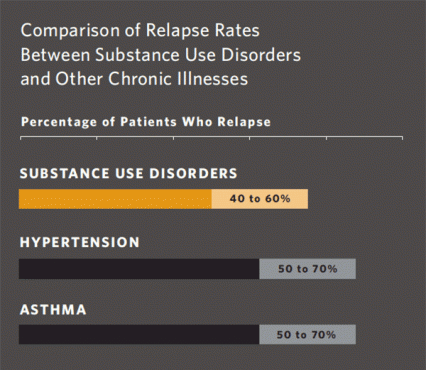 Relapse rates for patients with substance apply disorders are compared with those suffering from hypertension and asthma. Relapse is mutual and similar across these illnesses (equally is adherence to medication). Thus, drug addiction should be treated similar any other chronic illness, with relapse serving as a trigger for renewed intervention.
Source: McLellan et al., JAMA, 284:1689–1695, 2000.
Does relapse to drug use hateful treatment has failed?
No. The chronic nature of addiction means that relapsing to drug use is not only possible but also likely. Relapse rates are similar to those for other well-characterized chronic medical illnesses such as hypertension and asthma, which besides have both physiological and behavioral components. Relapse is the return to drug utilize after an effort to terminate. Treatment of chronic diseases involves changing securely imbedded behaviors. Lapses dorsum to drug utilize indicate that treatment needs to exist reinstated or adjusted, or that alternating treatment is needed. No single handling is right for everyone, and treatment providers must choose an optimal handling program in consultation with the individual patient and should consider the patient'southward unique history and circumstance.
How many people die from drug use?
The CDC reports that in 2016, the rate of overdose deaths was more than three times the rate in 1999.six The pattern of drugs involved in drug overdose deaths has changed in recent years. The rate of drug overdose deaths involving synthetic opioids other than methadone doubled from three.i per 100,000 in 2015 to 6.2 in 2016, with about half of all overdose deaths existence related to the synthetic opioid fentanyl, which is inexpensive to get and added to a variety of illicit drugs. For more data about drug overdose rates, please go to cdc.gov/drugoverdose/data.
Source: https://archives.drugabuse.gov/publications/media-guide/science-drug-use-addiction-basics
0 Response to "Four Critical Issues That Frequently Occur in Chemically Dependent Families."
Post a Comment