What Name Is Given to the Bond Between Water Molecules
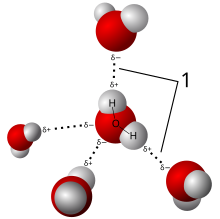
Model of hydrogen bonds (1) between molecules of water

AFM paradigm of napthalenetetracarboxylic diimide molecules on silver-terminated silicon, interacting via hydrogen bonding, taken at 77 G.[i] ("Hydrogen bonds" in the top epitome are exaggerated by artifacts of the imaging technique.[2] [3])
A hydrogen bond (or H-bond) is a primarily electrostatic forcefulness of attraction between a hydrogen (H) atom which is covalently leap to a more electronegative atom or group, and some other electronegative atom bearing a solitary pair of electrons—the hydrogen bond acceptor (Air-conditioning). Such an interacting system is more often than not denoted Dn–H···Air conditioning, where the solid line denotes a polar covalent bond, and the dotted or dashed line indicates the hydrogen bond.[four] The well-nigh frequent donor and acceptor atoms are the second-row elements nitrogen (N), oxygen (O), and fluorine (F).
Hydrogen bonds can be intermolecular (occurring between separate molecules) or intramolecular (occurring amid parts of the same molecule).[five] [6] [7] [8] The energy of a hydrogen bond depends on the geometry, the surround, and the nature of the specific donor and acceptor atoms, and can vary between 1 and 40 kcal/mol.[nine] This makes them somewhat stronger than a van der Waals interaction, and weaker than fully covalent or ionic bonds. This blazon of bond tin can occur in inorganic molecules such as h2o and in organic molecules like DNA and proteins. Hydrogen bonds are responsible for belongings such materials as newspaper and felted wool together, and for causing separate sheets of newspaper to stick together later on becoming wet and subsequently drying.
The hydrogen bond is responsible for many of the aberrant concrete and chemic backdrop of compounds of N, O, and F. In item, intermolecular hydrogen bonding is responsible for the loftier humid point of water (100 °C) compared to the other group-16 hydrides that take much weaker hydrogen bonds.[10] Intramolecular hydrogen bonding is partly responsible for the secondary and tertiary structures of proteins and nucleic acids. It besides plays an important function in the structure of polymers, both constructed and natural.
Bonding [edit]

Definitions and full general characteristics [edit]
A hydrogen atom attached to a relatively electronegative atom is the hydrogen bail donor.[12] C-H bonds only participate in hydrogen bonding when the carbon atom is bound to electronegative substituents, equally is the example in chloroform, CHCl3.[13] In a hydrogen bond, the electronegative atom not covalently attached to the hydrogen is named the proton acceptor, whereas the one covalently leap to the hydrogen is named the proton donor. While this nomenclature is recommended by the IUPAC,[four] information technology can exist misleading, since in other donor-acceptor bonds, the donor/acceptor consignment is based on the source of the electron pair (such classification is also used for hydrogen bonds by some authors[nine]). In the hydrogen bond donor, the H centre is protic. The donor is a Lewis base of operations. Hydrogen bonds are represented every bit H···Y arrangement, where the dots stand for the hydrogen bond. Liquids that display hydrogen bonding (such as water) are chosen associated liquids.

Examples of hydrogen bond donating (donors) and hydrogen bail accepting groups (acceptors)

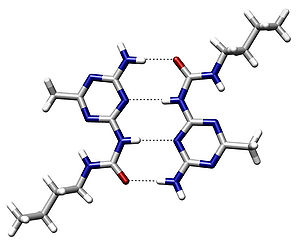
Cyclic dimer of acetic acrid; dashed dark-green lines represent hydrogen bonds
The hydrogen bond is ofttimes described as an electrostatic dipole-dipole interaction. However, it also has some features of covalent bonding: it is directional and strong, produces interatomic distances shorter than the sum of the van der Waals radii, and usually involves a limited number of interaction partners, which can be interpreted as a blazon of valence. These covalent features are more substantial when acceptors bind hydrogens from more electronegative donors.
As role of a more detailed list of criteria, the IUPAC publication acknowledges that the attractive interaction tin can arise from some combination of electrostatics (multipole-multipole and multipole-induced multipole interactions), covalency (accuse transfer by orbital overlap), and dispersion (London forces), and states that the relative importance of each will vary depending on the system. However, a footnote to the criterion recommends the exclusion of interactions in which dispersion is the primary correspondent, specifically giving Ar---CHiv and CH4---CH4 as examples of such interactions to be excluded from the definition.[4] Nonetheless, most introductory textbooks even so restrict the definition of hydrogen bond to the "classical" type of hydrogen bond characterized in the opening paragraph.
Weaker hydrogen bonds[14] are known for hydrogen atoms leap to elements such as sulfur (Southward) or chlorine (Cl); even carbon (C) can serve as a donor, particularly when the carbon or one of its neighbors is electronegative (e.1000., in chloroform, aldehydes and terminal acetylenes).[15] [16] Gradually, it was recognized that there are many examples of weaker hydrogen bonding involving donor other than North, O, or F and/or acceptor Ac with electronegativity approaching that of hydrogen (rather than existence much more electronegative). Though these "not-traditional" hydrogen bonding interactions are often quite weak (~1 kcal/mol), they are also ubiquitous and are increasingly recognized every bit important command elements in receptor-ligand interactions in medicinal chemistry or intra-/intermolecular interactions in materials sciences.
The definition of hydrogen bonding has gradually broadened over time to include these weaker bonny interactions. In 2011, an IUPAC Task Group recommended a modernistic evidence-based definition of hydrogen bonding, which was published in the IUPAC periodical Pure and Applied Chemistry. This definition specifies:
The hydrogen bond is an attractive interaction between a hydrogen atom from a molecule or a molecular fragment X–H in which X is more electronegative than H, and an atom or a group of atoms in the same or a different molecule, in which there is prove of bond formation.[17]
Bond strength [edit]
Hydrogen bonds can vary in strength from weak (1–2 kJ mol−ane) to strong (161.5 kJ mol−1 in the ion HF −
ii ).[18] [19] Typical enthalpies in vapor include:[20]
- F−H···:F (161.5 kJ/mol or 38.six kcal/mol), illustrated uniquely by HFii −, bifluoride
- O−H···:N (29 kJ/mol or vi.9 kcal/mol), illustrated h2o-ammonia
- O−H···:O (21 kJ/mol or five.0 kcal/mol), illustrated water-water, booze-alcohol
- Due north−H···:North (13 kJ/mol or 3.i kcal/mol), illustrated by ammonia-ammonia
- N−H···:O (8 kJ/mol or 1.9 kcal/mol), illustrated water-amide
- OH +
iii ···:OH
ii (18 kJ/mol[21] or 4.three kcal/mol)
The force of intermolecular hydrogen bonds is most often evaluated by measurements of equilibria between molecules containing donor and/or acceptor units, most oftentimes in solution.[22] The strength of intramolecular hydrogen bonds tin can be studied with equilibria between conformers with and without hydrogen bonds. The most of import method for the identification of hydrogen bonds also in complicated molecules is crystallography, sometimes also NMR-spectroscopy. Structural details, in particular distances between donor and acceptor which are smaller than the sum of the van der Waals radii can exist taken as indication of the hydrogen bond strength.
One scheme gives the following somewhat arbitrary classification: those that are 15 to 40 kcal/mol, 5 to fifteen kcal/mol, and >0 to five kcal/mol are considered stiff, moderate, and weak, respectively.
Resonance assisted hydrogen bail [edit]
The resonance assisted hydrogen bond (commonly abbreviated as RAHB) is a strong type of hydrogen bail. It is characterized past the π-delocalization that involves the hydrogen and cannot be properly described by the electrostatic model lone. This description of the hydrogen bond has been proposed to describe unusually short distances by and large observed between O=C-OH∙∙∙ or ∙∙∙O=C-C=C-OH.[ citation needed ]
Structural details [edit]
The X−H distance is typically ≈110 pm, whereas the H···Y distance is ≈160 to 200 pm. The typical length of a hydrogen bond in water is 197 pm. The ideal bail angle depends on the nature of the hydrogen bond donor. The following hydrogen bond angles between a hydrofluoric acid donor and various acceptors accept been adamant experimentally:[23]
| Acceptor···donor | VSEPR geometry | Bending (°) |
|---|---|---|
| HCN···HF | linear | 180 |
| H2CO···HF | trigonal planar | 120 |
| H2O···HF | pyramidal | 46 |
| HiiS···HF | pyramidal | 89 |
| SOtwo···HF | trigonal | 142 |
Spectroscopy [edit]
Strong hydrogen bonds are revealed by downfield shifts in the oneH NMR spectrum. For instance, the acidic proton in the enol tautomer of acetylacetone appears at δH fifteen.five, which is about 10 ppm downfield of a conventional alcohol.[24]
In the IR spectrum, hydrogen bonding shifts the 10-H stretching frequency to lower energy (i.eastward. the vibration frequency decreases). This shift reflects a weakening of the X-H bond. Sure hydrogen bonds - improper hydrogen bonds - show a blue shift of the X-H stretching frequency and a decrease in the bond length.[25] H-bonds can also exist measured by IR vibrational style shifts of the acceptor. The amide I mode of backbone carbonyls in α-helices shifts to lower frequencies when they form H-bonds with side-chain hydroxyl groups.[26]
Theoretical considerations [edit]
Hydrogen bonding is of persistent theoretical interest.[27] According to a mod description O:H-O integrates both the intermolecular O:H alone pair ":" nonbond and the intramolecular H-O polar-covalent bond associated with O-O repulsive coupling.[28]
Quantum chemical calculations of the relevant interresidue potential constants (compliance constants) revealed[ how? ] large differences between individual H bonds of the same type. For example, the central interresidue N−H···N hydrogen bond between guanine and cytosine is much stronger in comparison to the N−H···N bond betwixt the adenine-thymine pair.[29]
Theoretically, the bond strength of the hydrogen bonds can be assessed using NCI alphabetize, not-covalent interactions alphabetize, which allows a visualization of these non-covalent interactions, every bit its name indicates, using the electron density of the organisation.
From interpretations of the anisotropies in the Compton contour of ordinary ice that the hydrogen bond is partly covalent.[thirty] However, this interpretation was challenged.[31]
Near mostly, the hydrogen bail can be viewed equally a metric-dependent electrostatic scalar field between 2 or more than intermolecular bonds. This is slightly different from the intramolecular leap states of, for example, covalent or ionic bonds; still, hydrogen bonding is generally all the same a bound state miracle, since the interaction energy has a net negative sum. The initial theory of hydrogen bonding proposed by Linus Pauling suggested that the hydrogen bonds had a fractional covalent nature. This interpretation remained controversial until NMR techniques demonstrated data transfer between hydrogen-bonded nuclei, a feat that would just be possible if the hydrogen bond independent some covalent character.[32]
History [edit]
The concept of hydrogen bonding once was challenging.[33] Linus Pauling credits T. S. Moore and T. F. Winmill with the first mention of the hydrogen bond, in 1912.[34] [35] Moore and Winmill used the hydrogen bond to account for the fact that trimethylammonium hydroxide is a weaker base than tetramethylammonium hydroxide. The description of hydrogen bonding in its meliorate-known setting, water, came some years afterward, in 1920, from Latimer and Rodebush.[36] In that paper, Latimer and Rodebush cite piece of work by a fellow scientist at their laboratory, Maurice Loyal Huggins, saying, "Mr. Huggins of this laboratory in some piece of work as however unpublished, has used the idea of a hydrogen kernel held between two atoms equally a theory in regard to certain organic compounds."
Hydrogen bonds in small molecules [edit]
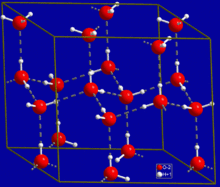
Crystal structure of hexagonal ice. Greyness dashed lines indicate hydrogen bonds

Water [edit]
A ubiquitous instance of a hydrogen bond is constitute betwixt water molecules. In a discrete water molecule, there are two hydrogen atoms and one oxygen atom. The simplest example is a pair of h2o molecules with one hydrogen bail betwixt them, which is called the water dimer and is frequently used as a model system. When more molecules are present, as is the example with liquid water, more bonds are possible because the oxygen of one water molecule has two lone pairs of electrons, each of which can form a hydrogen bail with a hydrogen on some other water molecule. This can repeat such that every h2o molecule is H-bonded with up to four other molecules, as shown in the figure (two through its two alone pairs, and two through its 2 hydrogen atoms). Hydrogen bonding strongly affects the crystal structure of ice, helping to create an open hexagonal lattice. The density of water ice is less than the density of water at the same temperature; thus, the solid phase of water floats on the liquid, unlike virtually other substances.
Liquid h2o's loftier boiling signal is due to the high number of hydrogen bonds each molecule can class, relative to its depression molecular mass. Owing to the difficulty of breaking these bonds, h2o has a very high boiling point, melting bespeak, and viscosity compared to otherwise similar liquids not conjoined by hydrogen bonds. H2o is unique because its oxygen atom has two lone pairs and two hydrogen atoms, significant that the total number of bonds of a water molecule is up to four.
The number of hydrogen bonds formed by a molecule of liquid water fluctuates with fourth dimension and temperature.[37] From TIP4P liquid water simulations at 25 °C, it was estimated that each h2o molecule participates in an average of 3.59 hydrogen bonds. At 100 °C, this number decreases to three.24 due to the increased molecular motility and decreased density, while at 0 °C, the boilerplate number of hydrogen bonds increases to iii.69.[37] Some other study found a much smaller number of hydrogen bonds: 2.357 at 25 °C.[38] The differences may be due to the use of a dissimilar method for defining and counting the hydrogen bonds.
Where the bond strengths are more equivalent, one might instead detect the atoms of two interacting h2o molecules partitioned into two polyatomic ions of opposite charge, specifically hydroxide (OH−) and hydronium (H3O+). (Hydronium ions are also known as "hydroxonium" ions.)
- H−O− H3O+
Indeed, in pure water under conditions of standard temperature and pressure, this latter conception is applicable just rarely; on boilerplate nearly one in every 5.5 × 10⁸ molecules gives up a proton to another water molecule, in accord with the value of the dissociation constant for water under such conditions. Information technology is a crucial role of the uniqueness of water.
Because water may form hydrogen bonds with solute proton donors and acceptors, it may competitively inhibit the formation of solute intermolecular or intramolecular hydrogen bonds. Consequently, hydrogen bonds between or within solute molecules dissolved in h2o are about always unfavorable relative to hydrogen bonds between water and the donors and acceptors for hydrogen bonds on those solutes.[39] Hydrogen bonds betwixt h2o molecules have an average lifetime of 10−11 seconds, or x picoseconds.[40]
Bifurcated and over-coordinated hydrogen bonds in water [edit]
A unmarried hydrogen cantlet can participate in two hydrogen bonds, rather than ane. This type of bonding is called "bifurcated" (dissever in 2 or "two-forked"). It can exist, for instance, in complex natural or synthetic organic molecules.[41] It has been suggested that a bifurcated hydrogen atom is an essential step in water reorientation.[42]
Acceptor-type hydrogen bonds (terminating on an oxygen'southward lonely pairs) are more likely to grade bifurcation (it is called overcoordinated oxygen, OCO) than are donor-type hydrogen bonds, offset on the aforementioned oxygen's hydrogens.[43]
Other liquids [edit]
For example, hydrogen fluoride—which has three lone pairs on the F atom just only i H atom—tin grade merely 2 bonds; (ammonia has the opposite problem: iii hydrogen atoms but only one lone pair).
- H−F···H−F···H−F
Farther manifestations of solvent hydrogen bonding [edit]
- Increment in the melting point, boiling point, solubility, and viscosity of many compounds tin can exist explained by the concept of hydrogen bonding.
- Negative azeotropy of mixtures of HF and water
- The fact that ice is less dense than liquid water is due to a crystal construction stabilized by hydrogen bonds.
- Dramatically higher boiling points of NHthree, H2O, and HF compared to the heavier analogues PHthree, H2S, and HCl, where hydrogen-bonding is absent.
- Viscosity of anhydrous phosphoric acid and of glycerol
- Dimer formation in carboxylic acids and hexamer formation in hydrogen fluoride, which occur even in the gas stage, resulting in gross deviations from the platonic gas law.
- Pentamer formation of water and alcohols in apolar solvents.
Hydrogen bonds in polymers [edit]
Hydrogen bonding plays an important part in determining the three-dimensional structures and the properties adopted by many synthetic and natural proteins. Compared to the C-C, C-O, and C-N bonds that comprise most polymers, hydrogen bonds are far weaker, mayhap five%. Thus, hydrogen bonds can be cleaved by chemical or mechanical means while retaining the basic structure of the polymer courage. This bureaucracy of bond strengths (covalent bonds beingness stronger than hydrogen-bonds beingness stronger than van der Waals forces) is cardinal to understanding the properties of many materials.[44]
Dna [edit]


In these macromolecules, bonding between parts of the same macromolecule crusade it to fold into a specific shape, which helps determine the molecule's physiological or biochemical part. For example, the double helical structure of DNA is due largely to hydrogen bonding between its base pairs (as well as pi stacking interactions), which link 1 complementary strand to the other and enable replication.
Proteins [edit]
In the secondary structure of proteins, hydrogen bonds form betwixt the backbone oxygens and amide hydrogens. When the spacing of the amino acrid residues participating in a hydrogen bail occurs regularly betwixt positions i and i + four, an alpha helix is formed. When the spacing is less, betwixt positions i and i + 3, and so a 3x helix is formed. When two strands are joined past hydrogen bonds involving alternating residues on each participating strand, a beta sheet is formed. Hydrogen bonds also play a office in forming the tertiary structure of protein through interaction of R-groups. (See likewise poly peptide folding).
Bifurcated H-bail systems are mutual in alpha-helical transmembrane proteins between the backbone amide C=O of residue i as the H-bond acceptor and two H-bond donors from residue i+4: the backbone amide N-H and a side-chain hydroxyl or thiol H+. The energy preference of the bifurcated H-bond hydroxyl or thiol system is -3.4 kcal/mol or -2.6 kcal/mol, respectively. This type of bifurcated H-bail provides an intrahelical H-bonding partner for polar side-chains, such equally serine, threonine, and cysteine inside the hydrophobic membrane environments.[26]
The role of hydrogen bonds in protein folding has likewise been linked to osmolyte-induced protein stabilization. Protective osmolytes, such as trehalose and sorbitol, shift the protein folding equilibrium toward the folded country, in a concentration dependent manner. While the prevalent explanation for osmolyte activity relies on excluded volume effects that are entropic in nature, circular dichroism (CD) experiments have shown osmolyte to act through an enthalpic event.[45] The molecular mechanism for their role in protein stabilization is even so not well established, though several mechanisms take been proposed. Computer molecular dynamics simulations suggest that osmolytes stabilize proteins by modifying the hydrogen bonds in the protein hydration layer.[46]
Several studies have shown that hydrogen bonds play an important role for the stability betwixt subunits in multimeric proteins. For example, a study of sorbitol dehydrogenase displayed an important hydrogen bonding network which stabilizes the tetrameric quaternary structure inside the mammalian sorbitol dehydrogenase protein family unit.[47]
A protein courage hydrogen bond incompletely shielded from water assail is a dehydron. Dehydrons promote the removal of water through proteins or ligand binding. The exogenous dehydration enhances the electrostatic interaction betwixt the amide and carbonyl groups past de-shielding their partial charges. Furthermore, the aridity stabilizes the hydrogen bond by destabilizing the nonbonded state consisting of dehydrated isolated charges.[48]
Wool, existence a protein fibre, is held together by hydrogen bonds, causing wool to recoil when stretched. However, washing at high temperatures tin permanently break the hydrogen bonds and a garment may permanently lose its shape.
Cellulose [edit]
Hydrogen bonds are important in the structure of cellulose and derived polymers in its many different forms in nature, such as cotton wool and flax.

A strand of cellulose (conformation Iα), showing the hydrogen bonds (dashed) within and between cellulose molecules
Synthetic polymers [edit]
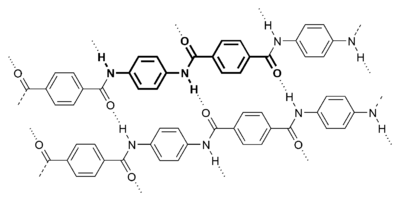
Many polymers are strengthened past hydrogen bonds within and between the chains. Among the synthetic polymers, a well characterized example is nylon, where hydrogen bonds occur in the repeat unit and play a major office in crystallization of the cloth. The bonds occur between carbonyl and amine groups in the amide echo unit. They effectively link next bondage, which assist reinforce the material. The outcome is swell in aramid fibre, where hydrogen bonds stabilize the linear chains laterally. The chain axes are aligned forth the fibre axis, making the fibres extremely stiff and stiff.
The hydrogen-bail networks brand both natural and synthetic polymers sensitive to humidity levels in the atmosphere because water molecules tin lengthened into the surface and disrupt the network. Some polymers are more than sensitive than others. Thus nylons are more sensitive than aramids, and nylon half dozen more sensitive than nylon-11.
Symmetric hydrogen bond [edit]
A symmetric hydrogen bond is a special blazon of hydrogen bond in which the proton is spaced exactly halfway betwixt ii identical atoms. The strength of the bond to each of those atoms is equal. Information technology is an example of a three-center 4-electron bail. This type of bond is much stronger than a "normal" hydrogen bond. The effective bond social club is 0.five, then its strength is comparable to a covalent bond. Information technology is seen in ice at high pressure, and also in the solid stage of many anhydrous acids such as hydrofluoric acid and formic acid at high pressure. It is also seen in the bifluoride ion [F--H--F]−. Due to astringent steric constraint, the protonated form of Proton Sponge (1,8-bis(dimethylamino)naphthalene) and its derivatives as well accept symmetric hydrogen bonds ([Northward--H--Northward]+),[49] although in the instance of protonated Proton Sponge, the assembly is bent.[fifty]
Dihydrogen bond [edit]
The hydrogen bond tin be compared with the closely related dihydrogen bond, which is besides an intermolecular bonding interaction involving hydrogen atoms. These structures have been known for some fourth dimension, and well characterized by crystallography;[51] however, an agreement of their relationship to the conventional hydrogen bond, ionic bond, and covalent bond remains unclear. By and large, the hydrogen bond is characterized by a proton acceptor that is a lone pair of electrons in nonmetallic atoms (well-nigh notably in the nitrogen, and chalcogen groups). In some cases, these proton acceptors may exist pi-bonds or metal complexes. In the dihydrogen bond, all the same, a metallic hydride serves as a proton acceptor, thus forming a hydrogen-hydrogen interaction. Neutron diffraction has shown that the molecular geometry of these complexes is similar to hydrogen bonds, in that the bond length is very adaptable to the metallic complex/hydrogen donor system.[51]
Dynamics probed by spectroscopic means [edit]
The dynamics of hydrogen bond structures in h2o tin be probed by the IR spectrum of OH stretching vibration.[52] In the hydrogen bonding network in protic organic ionic plastic crystals (POIPCs), which are a type of phase change material exhibiting solid-solid phase transitions prior to melting, variable-temperature infrared spectroscopy can reveal the temperature dependence of hydrogen bonds and the dynamics of both the anions and the cations.[53] The sudden weakening of hydrogen bonds during the solid-solid stage transition seems to be coupled with the onset of orientational or rotational disorder of the ions.[53]
Application to drugs [edit]
Hydrogen bonding is a key to the pattern of drugs. According to Lipinski's rule of 5 the majority of orally active drugs tend to have between 5 and x hydrogen bonds. These interactions be between nitrogen–hydrogen and oxygen–hydrogen centers.[54] As with many other rules of thumb, many exceptions be.
References [edit]
- ^ Sweetman, A. Grand.; Jarvis, South. P.; Sang, Hongqian; Lekkas, I.; Rahe, P.; Wang, Yu; Wang, Jianbo; Champness, N.R.; Kantorovich, L.; Moriarty, P. (2014). "Mapping the strength field of a hydrogen-bonded associates". Nature Communications. 5: 3931. Bibcode:2014NatCo...v.3931S. doi:10.1038/ncomms4931. PMC4050271. PMID 24875276.
- ^ Hapala, Prokop; Kichin, Georgy; Wagner, Christian; Tautz, F. Stefan; Temirov, Ruslan; Jelínek, Pavel (2014-08-nineteen). "Mechanism of loftier-resolution STM/AFM imaging with functionalized tips". Physical Review B. 90 (8): 085421. arXiv:1406.3562. Bibcode:2014PhRvB..90h5421H. doi:10.1103/PhysRevB.90.085421. S2CID 53610973.
- ^ Hämäläinen, Sampsa Yard.; van der Heijden, Nadine; van der Lit, Joost; den Hartog, Stephan; Liljeroth, Peter; Swart, Ingmar (2014-10-31). "Intermolecular Contrast in Atomic Forcefulness Microscopy Images without Intermolecular Bonds". Concrete Review Letters. 113 (18): 186102. arXiv:1410.1933. Bibcode:2014PhRvL.113r6102H. doi:10.1103/PhysRevLett.113.186102. hdl:1874/307996. PMID 25396382. S2CID 8309018. Archived from the original on 2018-01-20. Retrieved 2017-08-30 .
- ^ a b c Arunan, Elangannan; Desiraju, Gautam R.; Klein, Roger A.; Sadlej, Joanna; Scheiner, Steve; Alkorta, Ibon; Clary, David C.; Crabtree, Robert H.; Dannenberg, Joseph J. (2011-07-08). "Definition of the hydrogen bond (IUPAC Recommendations 2011)". Pure and Applied Chemistry. 83 (8): 1637–1641. doi:x.1351/PAC-REC-x-01-02. ISSN 1365-3075. S2CID 97688573.
- ^ Pimentel, Thou. The Hydrogen Bond Franklin Classics, 2018), ISBN 0343171600
- ^ Jeffrey, 1000. A.; An introduction to hydrogen bonding; Oxford university press New York, 1997. ISBN 0195095499
- ^ Jeffrey, Chiliad. A.; Saenger, W. Hydrogen bonding in biological structures; Springer: Berlin, 1994, 2012 Springer; ISBN 3540579036
- ^ IUPAC, Compendium of Chemical Terminology, 2nd ed. (the "Gilt Book") (1997). Online corrected version: (2006–) "hydrogen bond". doi:10.1351/goldbook.H02899
- ^ a b Steiner, Thomas (2002). "The Hydrogen Bond in the Solid Country". Angew. Chem. Int. Ed. 41 (one): 48–76. doi:10.1002/1521-3773(20020104)41:i<48::Help-ANIE48>3.0.CO;2-U. PMID 12491444.
- ^ Sabin, John R. (1971). "Hydrogen bonds involving sulfur. I. Hydrogen sulfide dimer". J. Am. Chem. Soc. 93 (15): 3613–3620. doi:x.1021/ja00744a012.
- ^ Beijer, Felix H.; Kooijman, Huub; Spek, Anthony L.; Sijbesma, Rint P.; Meijer, E. Westward. (1998). "Self-Complementarity Accomplished through Quadruple Hydrogen Bonding". Angew. Chem. Int. Ed. 37 (one–ii): 75–78. doi:10.1002/(SICI)1521-3773(19980202)37:1/2<75::Assistance-ANIE75>3.0.CO;2-R.
- ^ Campbell, Neil A.; Brad Williamson; Robin J. Heyden (2006). Biological science: Exploring Life. Boston, Massachusetts: Pearson Prentice Hall. ISBN978-0-xiii-250882-seven. Archived from the original on 2014-11-02. Retrieved 2008-11-11 .
- ^ Wiley, M.R.; Miller, South.I. (1972). "Thermodynamic parameters for hydrogen bonding of chloroform with Lewis bases in cyclohexane. Proton magnetic resonance study". Journal of the American Chemical Society. 94 (ten): 3287. doi:10.1021/ja00765a001.
- ^ Desiraju, Chiliad. R. and Steiner, T. The Weak Hydrogen Bond: In Structural Chemistry and Biology, International Union of Crystallography;2001, ISBN 0198509707
- ^ Nishio, K.; Hirota, Thousand.; Umezawa, Y. The CH–π Interactions; Wiley-VCH, New York, 1998. • Wiley-VCH; 1998) ISBN 0471252905
- ^ Nishio, M (2011). "The CH/[minor pi] hydrogen bond in chemistry. "Title". Phys. Chem. Chem. Phys. 13 (31): 13873–13900. doi:10.1039/c1cp20404a. PMID 21611676.
- ^ Arunan, Elangannan; Desiraju, Gautam R.; Klein, Roger A.; Sadlej, Joanna; Scheiner, Steve; Alkorta, Ibon; Clary, David C.; Crabtree, Robert H.; Dannenberg, Joseph J.; Hobza, Pavel; Kjaergaard, Henrik G.; Legon, Anthony C.; Mennucci, Benedetta; Nesbitt, David J. (2011). "Definition of the hydrogen bond". Pure Appl. Chem. 83 (8): 1637–1641. doi:10.1351/PAC-REC-ten-01-02. S2CID 97688573.
- ^ Larson, J. W.; McMahon, T. B. (1984). "Gas-stage bihalide and pseudobihalide ions. An ion cyclotron resonance decision of hydrogen bail energies in XHY- species (X, Y = F, Cl, Br, CN)". Inorganic Chemistry. 23 (14): 2029–2033. doi:ten.1021/ic00182a010.
- ^ Emsley, J. (1980). "Very Potent Hydrogen Bonds". Chemical Society Reviews. ix (1): 91–124. doi:x.1039/cs9800900091.
- ^ Five. David, N. Grinberg, S. C. Moldoveanu in Advances in Chromatography Book 54 (Eds.: E. Grushka, N. Grinberg), CRC Press, Boca Raton, 2018, affiliate 3.
- ^ Data obtained using molecular dynamics as detailed in the reference and should be compared to 7.9 kJ/mol for bulk water, obtained using the aforementioned calculation.Markovitch, Omer; Agmon, Noam (2007). "Construction and energetics of the hydronium hydration shells" (PDF). J. Phys. Chem. A. 111 (12): 2253–2256. Bibcode:2007JPCA..111.2253M. CiteSeerXx.i.1.76.9448. doi:x.1021/jp068960g. PMID 17388314. Archived from the original (PDF) on 2014-08-xiii. Retrieved 2017-10-25 .
- ^ Biedermann F, Schneider HJ (May 2016). "Experimental Binding Energies in Supramolecular Complexes". Chemical Reviews. 116 (9): 5216–300. doi:10.1021/acs.chemrev.5b00583. PMID 27136957.
- ^ Legon, A. C.; Millen, D. J. (1987). "Angular geometries and other properties of hydrogen-bonded dimers: a elementary electrostatic interpretation of the success of the electron-pair model". Chemical Guild Reviews. 16: 467. doi:10.1039/CS9871600467.
- ^ Friebolin, H., "Basic 1- and Two- Dimensional NMR Spectroscopy, fourth ed.," VCH: Weinheim, 2008. ISBN 978-3-527-31233-7
- ^ Hobza P, Havlas Z (2000). "Blue-Shifting Hydrogen Bonds". Chem. Rev. 100 (11): 4253–4264. doi:ten.1021/cr990050q. PMID 11749346.
- ^ a b Feldblum, Esther S.; Arkin, Isaiah T. (2014). "Strength of a bifurcated H bond". Proceedings of the National University of Sciences. 111 (11): 4085–4090. Bibcode:2014PNAS..111.4085F. doi:10.1073/pnas.1319827111. PMC3964065. PMID 24591597.
- ^ Weinhold, Frank; Klein, Roger A. (2014). "What is a hydrogen bond? Resonance covalency in the supramolecular domain". Chemical science Education Enquiry and Practice. 15 (3): 276–285. doi:ten.1039/c4rp00030g.
- ^ Sunday, C. Q.; Sun, Yi (2016). The Attribute of H2o: Unmarried Notion, Multiple Myths. ISBN978-981-10-0178-9.
- ^ Grunenberg, Jörg (2004). "Straight Assessment of Interresidue Forces in Watson−Crick Base of operations Pairs Using Theoretical Compliance Constants". Journal of the American Chemic Gild. 126 (50): 16310–1. doi:10.1021/ja046282a. PMID 15600318.
- ^ Isaacs, Eastward.D.; et al. (1999). "Covalency of the Hydrogen Bond in Ice: A Straight X-Ray Measurement". Physical Review Letters. 82 (3): 600–603. Bibcode:1999PhRvL..82..600I. doi:x.1103/PhysRevLett.82.600.
- ^ Ghanty, Tapan K.; Staroverov, Viktor N.; Koren, Patrick R.; Davidson, Ernest R. (2000-02-01). "Is the Hydrogen Bond in H2o Dimer and Water ice Covalent?". Journal of the American Chemic Gild. 122 (6): 1210–1214. doi:ten.1021/ja9937019. ISSN 0002-7863.
- ^ Cordier, F; Rogowski, M; Grzesiek, S; Bax, A (1999). "Observation of through-hydrogen-bond (2h)J(HC') in a perdeuterated protein". J Magn Reson. 140 (2): 510–2. Bibcode:1999JMagR.140..510C. doi:10.1006/jmre.1999.1899. PMID 10497060. S2CID 121429.
- ^ Needham, Paul (2013). "Hydrogen bonding: Homing in on a catchy chemical concept". Studies in History and Philosophy of Science Part A. 44 (1): 51–65. Bibcode:2013SHPSA..44...51N. doi:10.1016/j.shpsa.2012.04.001.
- ^ Pauling, Fifty. (1960). The nature of the chemical bond and the construction of molecules and crystals; an introduction to mod structural chemistry (third ed.). Ithaca (NY): Cornell University Press. p. 450. ISBN978-0-8014-0333-0.
- ^ Moore, T. S.; Winmill, T. F. (1912). "The state of amines in aqueous solution". J. Chem. Soc. 101: 1635. doi:10.1039/CT9120101635.
- ^ Latimer, Wendell M.; Rodebush, Worth H. (1920). "Polarity and ionization from the standpoint of the Lewis theory of valence". Journal of the American Chemical Guild. 42 (vii): 1419–1433. doi:10.1021/ja01452a015.
- ^ a b Jorgensen, W. L.; Madura, J. D. (1985). "Temperature and size dependence for Monte Carlo simulations of TIP4P water". Mol. Phys. 56 (6): 1381. Bibcode:1985MolPh..56.1381J. doi:ten.1080/00268978500103111.
- ^ Zielkiewicz, Jan (2005). "Structural backdrop of water: Comparison of the SPC, SPCE, TIP4P, and TIP5P models of water". J. Chem. Phys. 123 (ten): 104501. Bibcode:2005JChPh.123j4501Z. doi:x.1063/one.2018637. PMID 16178604.
- ^ Jencks, William; Jencks, William P. (1986). "Hydrogen Bonding between Solutes in Aqueous Solution". J. Am. Chem. Soc. 108 (14): 4196. doi:ten.1021/ja00274a058.
- ^ Dillon, P. F. (2012). Biophysics: A Physiological Approach. Cambridge University Press. p. 37. ISBN978-one-139-50462-one.
- ^ Baron, Michel; Giorgi-Renault, Sylviane; Renault, Jean; Mailliet, Patrick; Carré, Daniel; Etienne, Jean (1984). "Hétérocycles à fonction quinone. V. Réaction anormale de la butanedione avec la diamino-ane,2 anthraquinone; construction cristalline de la naphto \2,three-f] quinoxalinedione-7,12 obtenue". Can. J. Chem. 62 (iii): 526–530. doi:10.1139/v84-087.
- ^ Laage, Damien; Hynes, James T. (2006). "A Molecular Bound Mechanism for Water Reorientation". Science. 311 (5762): 832–5. Bibcode:2006Sci...311..832L. doi:10.1126/science.1122154. PMID 16439623. S2CID 6707413.
- ^ Markovitch, Omer; Agmon, Noam (2008). "The Distribution of Acceptor and Donor Hydrogen-Bonds in Bulk Liquid Water". Molecular Physics. 106 (two): 485. Bibcode:2008MolPh.106..485M. doi:10.1080/00268970701877921. S2CID 17648714.
- ^ Shiao-Wei Kuo (2018). Hydrogen Bonding in Polymer Materials. Wiley-VCH.
- ^ Politi, Regina; Harries, Daniel (2010). "Enthalpically driven peptide stabilization by protective osmolytes". ChemComm. 46 (35): 6449–6451. doi:10.1039/C0CC01763A. PMID 20657920.
- ^ Gilman-Politi, Regina; Harries, Daniel (2011). "Unraveling the Molecular Mechanism of Enthalpy Driven Peptide Folding by Polyol Osmolytes". Journal of Chemic Theory and Ciphering. seven (11): 3816–3828. doi:x.1021/ct200455n. PMID 26598272.
- ^ Hellgren, G.; Kaiser, C.; de Haij, S.; Norberg, A.; Höög, J. O. (Dec 2007). "A hydrogen-bonding network in mammalian sorbitol dehydrogenase stabilizes the tetrameric land and is essential for the catalytic power". Cellular and Molecular Life Sciences. 64 (23): 3129–38. doi:10.1007/s00018-007-7318-1. PMID 17952367. S2CID 22090973.
- ^ Fernández, A.; Rogale Grand.; Scott Ridgway; Scheraga H. A. (June 2004). "Inhibitor design by wrapping packing defects in HIV-ane proteins". Proceedings of the National Academy of Sciences. 101 (32): 11640–5. Bibcode:2004PNAS..10111640F. doi:10.1073/pnas.0404641101. PMC511032. PMID 15289598.
- ^ Khashayar Rajabimoghadam Yousef Darwish Umyeena Bashir Dylan Pitman Sidney Eichelberger Maxime A. Siegler Marcel Swart Isaac Garcia-Bosch Aerobic Oxidation of Alcohols by Copper Complexes Bearing Redox-Active Ligands with Tunable H-Bonding https://doi.org/10.1021/jacs.8b08748
- ^ Ozeryanskii, Valery A.; Pozharskii, Alexander F.; Bieńko, Agnieszka J.; Sawka-Dobrowolska, Wanda; Sobczyk, Lucjan (2005-03-01). "[NHN]+ Hydrogen Bonding in Protonated 1,8-Bis(dimethylamino)-ii,vii-dimethoxynaphthalene. X-ray Diffraction, Infrared, and Theoretical ab Initio and DFT Studies". The Journal of Concrete Chemistry A. 109 (8): 1637–1642. Bibcode:2005JPCA..109.1637O. doi:10.1021/jp040618l. ISSN 1089-5639. PMID 16833488.
- ^ a b Crabtree, Robert H.; Siegbahn, Per E. M.; Eisenstein, Odile; Rheingold, Arnold Fifty.; Koetzle, Thomas F. (1996). "A New Intermolecular Interaction: Unconventional Hydrogen Bonds with Element-Hydride Bonds as Proton Acceptor". Acc. Chem. Res. 29 (7): 348–354. doi:ten.1021/ar950150s. PMID 19904922.
- ^ Cowan ML; Bruner BD; Huse North; et al. (2005). "Ultrafast retentivity loss and energy redistribution in the hydrogen bond network of liquid H2O". Nature. 434 (7030): 199–202. Bibcode:2005Natur.434..199C. doi:10.1038/nature03383. PMID 15758995. S2CID 4396493.
- ^ a b Luo, Jiangshui; Jensen, Annemette H.; Brooks, Neil R.; Sniekers, Jeroen; Knipper, Martin; Aili, David; Li, Qingfeng; Vanroy, Bram; Wübbenhorst, Michael; Yan, Feng; Van Meervelt, Luc; Shao, Zhigang; Fang, Jianhua; Luo, Zheng-Hong; De Vos, Dirk Due east.; Binnemans, Koen; Fransaer, Jan (2015). "1,2,iv-Triazolium perfluorobutanesulfonate as an archetypal pure protic organic ionic plastic crystal electrolyte for all-solid-state fuel cells". Energy & Environmental Science. viii (four): 1276. doi:10.1039/C4EE02280G. S2CID 84176511.
- ^ Lipinski CA (Dec 2004). "Lead- and drug-like compounds: the rule-of-v revolution". Drug Discovery Today: Technologies. 1 (4): 337–341. doi:10.1016/j.ddtec.2004.11.007. PMID 24981612.
Further reading [edit]
- George A. Jeffrey. An Introduction to Hydrogen Bonding (Topics in Physical Chemistry). Oxford Academy Printing, Us (March thirteen, 1997). ISBN 0-19-509549-9
External links [edit]
- The Bubble Wall (Sound slideshow from the National High Magnetic Field Laboratory explaining cohesion, surface tension and hydrogen bonds)
- isotopic effect on bond dynamics
Source: https://en.wikipedia.org/wiki/Hydrogen_bond
0 Response to "What Name Is Given to the Bond Between Water Molecules"
Post a Comment